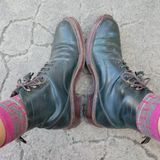
The Derby Boots 1628 are a Goodyear welted derby boot model manufactured by Carmina Shoemaker. Built on the Oscaria last, the boots feature a calf leather upper with synthetic layers that create a waxy, shiny finish, paired with Silver soles designed for durability in wet conditions.
The model is part of Carmina's work boot collection, utilizing the company's sportier Oscaria last which provides a wider fit with a rounded toe area. Like all Carmina footwear, the 1628 boots are hand-crafted using traditional Goodyear welt construction methods that have been employed by the Mallorca-based manufacturer since 1905.
The Derby Boots 1628 are constructed on Carmina's Oscaria last, characterized by its width and rounded toe area. The last is slightly shorter overall than other Carmina lasts and provides more space in the front area, making it suitable for derby boot designs with a masculine aesthetic. The Oscaria features a wide fitting with a tall, rounded tip.
Carmina typically manufactures robust-looking footwear with the Oscaria last, often pairing it with rubber soles such as the Alfil, Silver, or Tramuntana. This last design prioritizes comfort and durability for casual and work boot applications.
The upper material consists of calf leather treated with synthetic layers that give the leather a waxy and shiny finish. This leather treatment makes the material particularly suitable for Goodyear stitching. The boots feature calfskin lining that molds to the wearer's foot over time.
The Derby Boots 1628 utilize Silver soles, which are thicker than Carmina's York and Tomir sole options and feature greater texture. Silver soles cover and protect the complete sole, making them ideal for laced boots worn on rainy days or cobblestoned streets.
All Carmina shoes are hand-crafted and Goodyear-welted, with uppers that are hand-cut from leather. Carmina employs closed channel Goodyear welt construction, where the stitching is concealed inside the sole for a more refined appearance.
The manufacturing process takes 15 to 20 days and involves 11 clearly defined stages: preparation of the last, design, pattern making, material selection, cutting, sewing, assembly, stitching of welting and soles, smoothing edges, dyeing and polishing, and finishing. Cutting is done by hand, with pieces carefully sewn together. Uppers are molded over lasts where they rest for four days before the welts and soles are stitched. The construction is durable, water resistant, and resoleable, with Goodyear welted shoes capable of being rebuilt three to four times with moderate use.
Each shoe is crafted using precision and techniques passed down through generations at Carmina's Mallorca facility, where the company's presence was established in 1866, predating the invention of the Goodyear welt itself. The company began making Goodyear welted dress shoes and boots in 1905.
"DERBY BOOTS 1628 OSCARIA". Carmina Shoemaker. Retrieved November 28, 2025.
"OSCARIA LASTS SHOES". Carmina Shoemaker. Retrieved November 28, 2025.
"Why should you choose a Goodyear welted shoe?". Carmina Shoemaker. Retrieved November 28, 2025.
"Carmina Plain Toe Derby Shoes Review: Price, Where to Buy, and Size Advice". Esquire. Retrieved November 28, 2025.
"How we make our shoes". Carmina Shoemaker. Retrieved November 28, 2025.
Sven Raphael Schneider. "Carmina: Is It Worth It? (Men's Luxury Dress Shoe Review)". Gentleman's Gazette. Retrieved November 28, 2025.