Hender Scheme
MakerAbout
Hender Scheme is a Japanese footwear and accessories label founded in 2010 by designer Ryo Kashiwazaki in Tokyo. The brand produces handmade leather footwear, bags, and accessories in the Asakusa district, where local artisan workshops craft each product using vegetable-tanned leather and traditional techniques. Hender Scheme gained international recognition for its Manual Industrial Products line, which reproduces iconic sneaker designs entirely by hand in premium leather, transforming mass-produced athletic footwear into artisanal luxury goods.
About
Hender Scheme is a Japanese footwear and accessories label founded in 2010 by designer Ryo Kashiwazaki in Tokyo. The brand produces handmade leather footwear, bags, and accessories in the Asakusa district, where local artisan workshops craft each product using vegetable-tanned leather and traditional techniques. Hender Scheme gained international recognition for its Manual Industrial Products line, which reproduces iconic sneaker designs entirely by hand in premium leather, transforming mass-produced athletic footwear into artisanal luxury goods.
The brand's philosophy centers on celebrating materials that develop patina over time, particularly vegetable-tanned leather that changes in tone and texture through use. This emphasis on aging and transformation informs all aspects of Hender Scheme's work, from material selection to product design and customer education.
Founding and Designer Background
Ryo Kashiwazaki founded Hender Scheme in 2010 in Tokyo, establishing the brand at age 29 after working in fashion design and pattern making. The brand name "Hender Scheme" references gender schema theory from developmental psychology, which examines how cultural conditioning shapes perceptions of gender-appropriate behavior and appearance.
This conceptual foundation suggests Kashiwazaki's interest in questioning received categories and boundaries, an approach evident in the brand's work transforming athletic sneakers into luxury goods and challenging distinctions between high and low culture in footwear.
Kashiwazaki's background in pattern making proved essential to the Manual Industrial Products line, as accurately reproducing existing sneaker designs requires exceptional technical skill in pattern development and three-dimensional construction.
Asakusa Production and Artisan Workshops
Hender Scheme produces all footwear and leather goods in Tokyo's Asakusa district, a neighborhood with deep historical connections to leather working and traditional crafts. Asakusa's concentration of small artisan workshops provides access to specialized skills and equipment necessary for handmade leather production.
The brand works with local artisans operating from individual workshops, each specializing in particular aspects of leather goods production. This network approach allows Hender Scheme to maintain relatively small production scale while accessing expertise across multiple specialties including pattern making, cutting, stitching, lasting, and finishing.
Each product is meticulously handmade by these artisans, with production processes emphasizing traditional techniques passed down through generations. The Asakusa location places Hender Scheme within a community of makers maintaining traditional Japanese craft approaches despite modern manufacturing alternatives.
Vegetable-Tanned Leather
Hender Scheme uses exclusively vegetable-tanned leather for its footwear and accessories. Vegetable tanning employs organic tannins from tree bark, leaves, and other plant materials, producing leather with superior aging characteristics compared to chrome-tanned alternatives.
The selection of vegetable-tanned leather directly supports the brand's emphasis on patina development. Vegetable-tanned leather changes dramatically over time, darkening with exposure to light and oils while developing surface polish from handling. These changes create visible history of the product's use, with each item developing unique character based on individual wearing patterns.
The material choice also connects Hender Scheme to traditional Japanese leather craft, as vegetable tanning represents the historical method used before industrial chrome tanning became dominant in the mid-20th century.
The leather's ability to change tone and texture over time transforms static products into dynamic objects that evolve with their owners. This temporal dimension distinguishes vegetable-tanned leather goods from products engineered to maintain consistent appearance indefinitely.
Manual Industrial Products
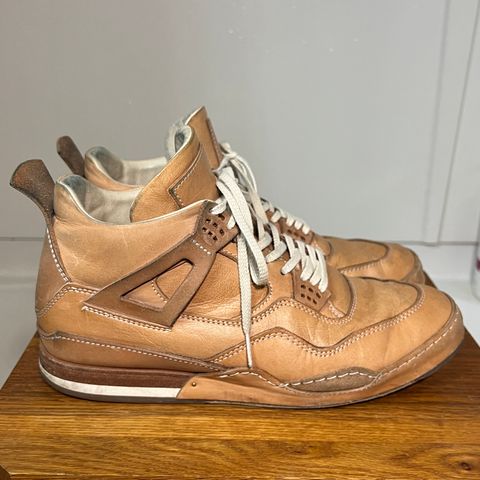
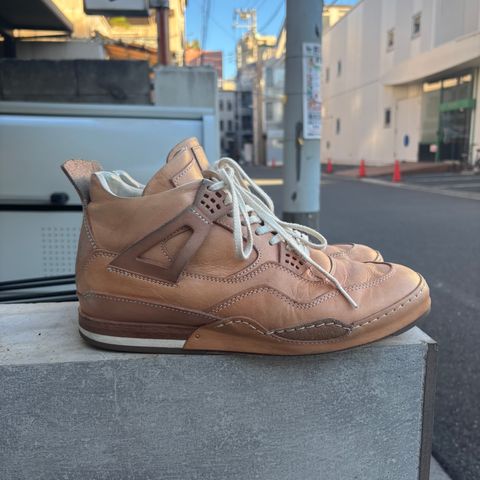
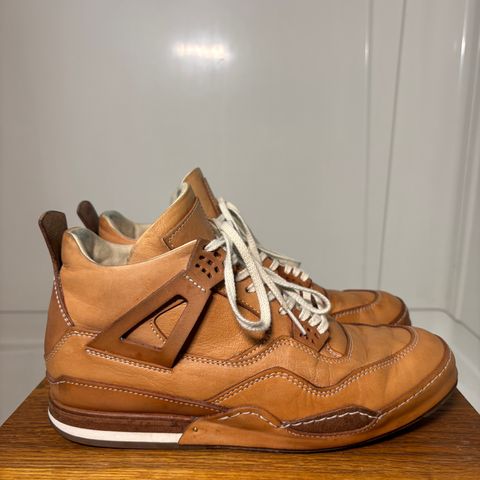
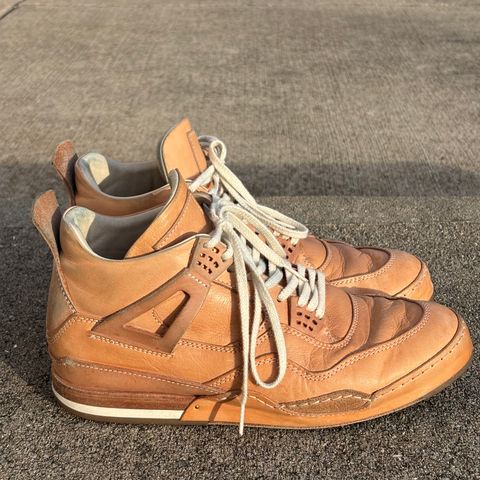
The Manual Industrial Products (MIP) line represents Hender Scheme's most recognizable work, reproducing iconic sneaker designs entirely by hand in premium leather. The concept transforms mass-produced athletic footwear into limited-production artisanal goods, inverting typical relationships between originals and copies.
The MIP line includes handmade leather versions of the Nike Air Force 1, Air Jordan IV, Vans Half Cab, and Clarks Wallabee, among other recognizable models. Each reproduction maintains the original's silhouette and design details while substituting vegetable-tanned leather for synthetic materials and handwork for industrial production.
The creation process requires exceptional technical skill, as sneaker patterns must be reverse-engineered from finished products, then adapted for hand construction using traditional shoemaking techniques. Elements like toe bumpers, heel counters, and complex multi-piece uppers present significant challenges when executed without industrial machinery.
The MIP line raises questions about authenticity, value, and craft in contemporary culture. By transforming designs created for mass production into handmade luxury goods, Hender Scheme challenges assumptions about which products deserve artisanal treatment. The work suggests that design quality exists independent of production method, and that handcraft can reveal hidden sophistication in utilitarian objects.
Product Range Beyond Footwear
While best known for footwear, Hender Scheme produces an extensive range of leather accessories including belts, bucket hats, folios, laptop sleeves, notebooks, and keychains. These products apply the brand's philosophy of handmade construction and aging materials to everyday objects.
The accessories line demonstrates Hender Scheme's belief that the principles of craft and material quality apply equally to small goods as to primary products like footwear. A keychain receives the same attention to leather selection, stitching, and edge finishing as a boot, reflecting commitment to consistent standards across all offerings.
Many accessories serve functional purposes while celebrating leather's aging characteristics. Laptop sleeves and folios designed for daily use develop patina quickly, transforming from uniform tan to rich brown with visible handling marks. This accelerated patina process makes accessories effective ambassadors for the brand's material philosophy.
Japanese Craft Tradition
Hender Scheme operates within Japanese craft traditions emphasizing meticulous attention to detail, material respect, and continuous refinement. The brand's approach reflects concepts including monozukuri, a term encompassing the spirit of making things with dedication and pride in workmanship.
The emphasis on materials that change over time connects to Japanese aesthetic concepts like wabi-sabi, which finds beauty in impermanence and the marks of age. By celebrating patina rather than pristine newness, Hender Scheme aligns with longstanding Japanese appreciation for objects that reveal their history through visible wear.
The collaboration with Asakusa artisan workshops maintains traditional craft relationships where designers and specialized makers work together rather than concentrating all skills within a single factory. This distributed production model preserves specialized expertise while allowing designers to focus on creative development.
Market Position and International Reception
Hender Scheme occupies a distinctive market position, combining Japanese craft tradition with contemporary fashion sensibility and conceptual depth. The brand appeals to customers interested in both material quality and the intellectual framework around the products.
International reception has been particularly strong in fashion-conscious markets appreciating the conceptual sophistication of the MIP line. The brand's work resonates with audiences interested in exploring boundaries between high and low culture, original and reproduction, industrial and artisanal production.
Hender Scheme products command premium pricing reflecting handmade production, premium materials, and limited production scale. An MIP sneaker reproduction costs significantly more than the original mass-produced version it references, with pricing justified by craftsmanship, materials, and conceptual value rather than brand heritage alone.
The brand distributes through select retailers worldwide who can communicate the conceptual framework and material philosophy to customers. This curated distribution maintains brand positioning while reaching an international audience.
Design Philosophy
Hender Scheme's design philosophy emphasizes transformation, both in the sense of transforming existing designs through manual reproduction and in materials transforming through use. This dual emphasis on transformation creates products that change dramatically from purchase through extended ownership.
The brand's work questions boundaries between categories including luxury and utility, fashion and craft, Japanese and Western design traditions. By operating across these boundaries rather than within established categories, Hender Scheme creates distinctive space in contemporary footwear and accessories.
The commitment to handmade production in an era of industrial dominance represents both practical choice and philosophical statement. Hender Scheme demonstrates that handcraft remains viable for producing contemporary products while offering qualities unavailable through mechanized alternatives.
References
"Handmade leather sneakers from Hender Scheme and luxury goods in Japan". Japanese Tease. Retrieved November 2025.
"A Look Inside the Hender Scheme Studio in Tokyo". Freshness Mag. Retrieved November 2025.
"Hender Scheme". Hypebeast. Retrieved November 2025.