Grenson
MakerAbout
Grenson is a British footwear company founded in 1866 by shoemaker William Green in Rushden, Northamptonshire. The company established itself as one of the first factories in the world to use Goodyear welt construction methods, becoming particularly renowned for its classic brogues, oxfords, and dress shoes. Operating continuously for over 155 years, Grenson represents one of England's longest-established shoemaking firms, maintaining manufacturing operations in Northamptonshire while adapting to contemporary fashion markets.
About
Grenson is a British footwear company founded in 1866 by shoemaker William Green in Rushden, Northamptonshire. The company established itself as one of the first factories in the world to use Goodyear welt construction methods, becoming particularly renowned for its classic brogues, oxfords, and dress shoes. Operating continuously for over 155 years, Grenson represents one of England's longest-established shoemaking firms, maintaining manufacturing operations in Northamptonshire while adapting to contemporary fashion markets.
The brand name Grenson, derived from "Green and Sons," was officially adopted in 1913 and became one of the earliest registered trade names in British shoemaking. Under the ownership of Tim Little since 2010, Grenson has experienced significant revitalization while preserving traditional Goodyear welt construction techniques that require over 200 individual operations and up to eight weeks per pair of shoes.
History
William Green began his shoemaking career in 1866 in a loft above the Corn Merchants in Rushden, Northamptonshire. Initially working as a traditional shoemaker, Green transitioned to operating as a "factor," a role that involved securing orders, sourcing materials, and employing craftsmen to fulfill commissions. This organizational approach allowed Green to attract skilled shoe craftsmen and formalize operations as William Green & Son.
The company's success enabled Green to open his first dedicated factory in 1874, consolidating production under one roof. By 1896, the business had expanded sufficiently to warrant construction of a purpose-built facility, the Cromwell Works, located at the corner of Queen Street and Cromwell Road in Rushden. This factory represented state-of-the-art manufacturing capabilities for its era and would serve as Grenson's home for over a century.
Following William Green's death, his son CAK Green assumed control of the business in 1913. At this time, the company name was shortened from William Green & Sons to Grenson, establishing the brand identity that would endure through the following decades. The Grenson name was registered as one of the first trade names in the United Kingdom, reflecting the growing importance of brand identity in British manufacturing.
The company remained at the Cromwell Works location until 2013, when operations moved to a third factory location, also in Northamptonshire. Throughout the 20th century, Grenson maintained its traditional production methods while adapting to changing market conditions and fashion trends.
Tim Little joined Grenson as creative director in 2005, subsequently acquiring the company in 2010. At the time of acquisition, Grenson was loss-making and lacked retail presence in London, presenting significant challenges for the new owner. Little's leadership focused on revitalizing the brand through product innovation and market repositioning while preserving the company's traditional manufacturing heritage.
Manufacturing and Construction
Grenson was among the first factories globally to adopt the Goodyear welt construction method, a technique invented in England during the 1800s. This labor-intensive process involves stitching a leather strip called a welt to attach the upper to the sole, creating a durable bond that allows shoes to be resoled repeatedly throughout their lifespan. The complexity of Grenson's manufacturing process requires over 200 individual operations and can take up to eight weeks to complete a single pair of shoes.
The company currently operates manufacturing facilities in both Northamptonshire, England, and India, allowing for different product tiers to serve various market segments. The English facility handles premium production, while the Indian factory provides hand-stitching capabilities noted for their quality and enables broader market accessibility through varied price points.
Grenson's product categorization system reflects this multi-location manufacturing structure. The G:One designation indicates shoes fully manufactured in the Northampton factory using traditional methods. G:Two denotes production in Grenson's Indian facility, while G:Lab represents custom variants crafted in Northampton. The G:Zero classification indicates the highest tier of production, though specific details of this designation are not extensively documented.
Triple Welt Innovation
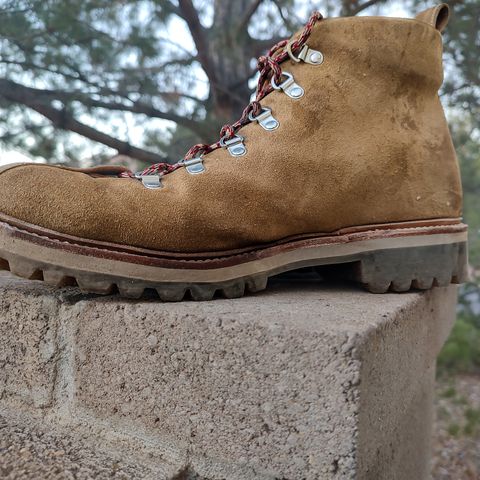
A significant innovation in Grenson's manufacturing approach emerged from the company's "making room" when a welting craftsman experimented with leather offcuts to develop an alternative welt construction. This experimentation produced the Triple Welt, a distinctive stepped construction featuring three layers of welt that amplifies the visual and structural presence of Goodyear welted shoemaking.
The Triple Welt represents a departure from standard single-welt construction while maintaining the fundamental benefits of the Goodyear welt method. This innovation allowed Grenson to create visually distinctive products that emphasize the craftsmanship of traditional construction while appealing to contemporary aesthetic preferences for bold, substantial footwear.
Tim Little embraced this innovation, incorporating the Triple Welt into signature models and developing it into a distinct collection. The technique has become closely associated with Grenson's modern identity, distinguishing the brand's offerings from traditional Northamptonshire shoemakers while maintaining connection to heritage construction methods.
Product Lines and Notable Models
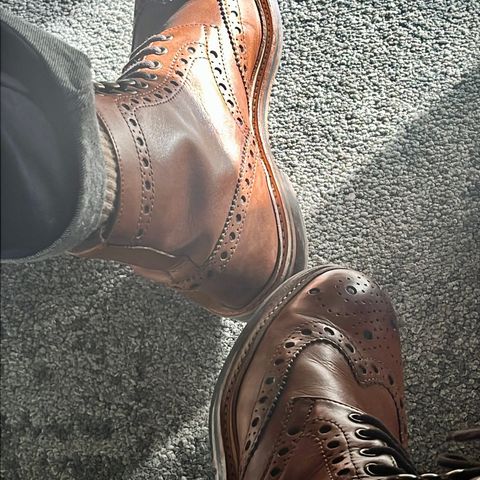
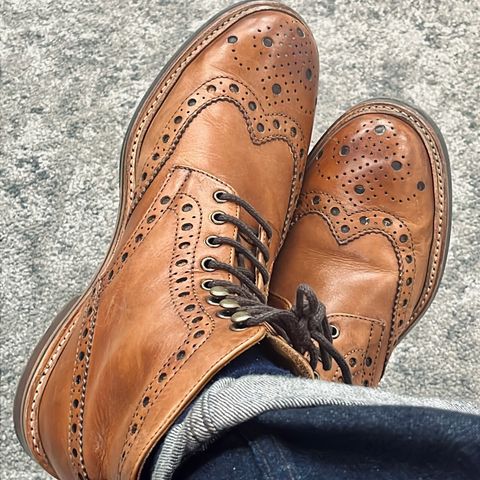
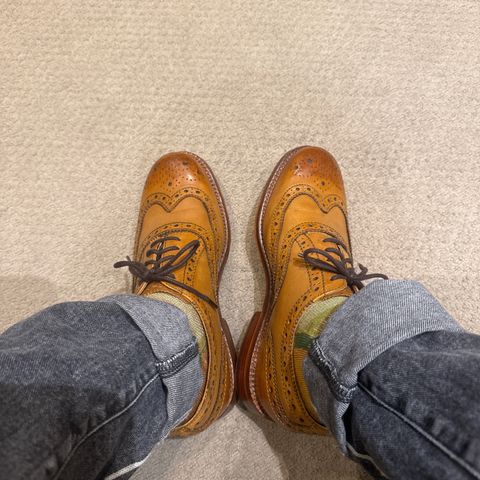
Grenson's product range centers on classic English shoe styles, particularly brogues, oxfords, and loafers, complemented by boots and casual footwear. The company has produced brogues since its early years, maintaining consistent medallion signature details that have become characteristic of the brand's aesthetic.
The Archie model, created by Tim Little approximately ten years after joining the company, represents Grenson's best-selling design. This full English brogue features Gibson construction rather than oxford styling, with exaggerated design elements including oversized brogue punching, a substantial triple sole, and triple welt construction. The Archie's bold proportions epitomize Grenson's contemporary design direction under Little's leadership, balancing traditional brogue elements with amplified, visually striking details.
The brand's offerings span from classic dress shoes maintaining traditional proportions and styling to more contemporary interpretations featuring Triple Welt construction and substantial sole units. This range allows Grenson to serve both traditional formal footwear customers and fashion-oriented consumers seeking distinctive, craft-focused designs.
Brand Recognition and Cultural Presence
Grenson's lengthy operating history and consistent quality have established the company as a recognized name in British shoemaking. The brand's traditional brogues and oxfords are regarded as exemplars of Northamptonshire footwear craftsmanship, maintaining relevance in both formal menswear and contemporary fashion contexts.
The company's shoes have appeared in notable cultural productions, including providing footwear for the film "The Great Gatsby," demonstrating Grenson's ability to meet period-accurate production requirements for 1920s-era footwear. This cultural visibility has complemented the brand's presence in menswear retail and fashion media.
Under Tim Little's ownership, Grenson has expanded its retail presence significantly from its loss-making position in 2010, developing distribution channels and brand recognition beyond traditional formal footwear markets. The company's combination of heritage craftsmanship and contemporary design has positioned it within the broader resurgence of interest in traditional shoemaking and quality menswear.
Legacy and Continuing Operation
Grenson's continuous operation since 1866 represents one of the longest-running footwear businesses in Britain, surviving economic fluctuations, world wars, and fundamental changes in the footwear industry. The company's ability to maintain manufacturing in Northamptonshire while many British footwear firms closed or relocated production entirely offshore demonstrates both the brand's commitment to traditional methods and the viability of premium domestic manufacturing.
The brand's evolution under Tim Little's ownership illustrates the challenges and opportunities facing heritage manufacturing firms in contemporary markets. By preserving Goodyear welt construction and Northamptonshire production while introducing innovations like the Triple Welt and pursuing contemporary design directions, Grenson has successfully adapted historical craftsmanship to current market conditions.
The company continues to manufacture shoes in its Northamptonshire facility, maintaining the skills and techniques that have defined English shoemaking for over a century while serving both traditional dress shoe customers and fashion-oriented consumers seeking authentic, craft-based footwear.
References
"Heritage and History". Grenson. Retrieved November 11, 2025.
"How We Make Our Shoes". Grenson. Retrieved November 11, 2025.
"At Grenson's Shoe Factory". Spitalfields Life. October 19, 2011. Retrieved November 11, 2025.
"Grenson's History". Rushden Research Group. Retrieved November 11, 2025.
"Grenson". Northamptonshire Boot and Shoe. Retrieved November 11, 2025.
"Grenson: Celebrating 150 Years of British Craftsmanship". AllSole. Retrieved November 11, 2025.
"Cromwell Works, William Green & Sons (Grenson Shoe Factory)". Northamptonshire's Historic Environment Record. Retrieved November 11, 2025.