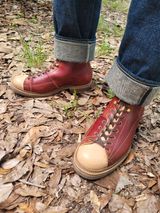
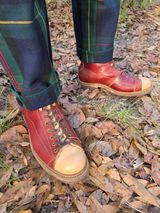
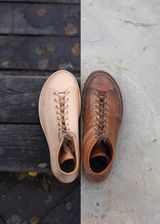
Conceria Cloe Horsebutt is a vegetable-tanned horse leather produced by Conceria Cloe, an Italian tannery located in Ponte a Égola, Toscana. The leather is cut from the hind section of the horse hide, positioned above the shell cordovan layer, and features all three layers of the hide including the grain, shell cordovan, and flesh layers.
The leather is used for heritage footwear construction and leather goods, valued for its dense fiber structure and ability to develop patina over time. Conceria Cloe produces horsebutt in multiple color finishes including Black, Burgundy, Crust, Lux, Mahogany, Natural, Superlux, and Superlux Overdyed Black.
Horsebutt is cut from the rump area of the horse hide, positioned above the shell cordovan layer. The leather comprises all three layers from the horse's rear: the grain layer, shell cordovan layer, and innermost flesh layer. This multi-layer composition differentiates it from shell cordovan, which uses only the isolated shell layer beneath the skin.
Conceria Cloe produces the horsebutt using full vegetable tanning in pit, part of their specialized production of horse leathers including shell cordovan, horse avancorpo, and horse culatta. The leather is tanned without pigmentation, leaving it in an unfinished, natural state. Horse rump leather can be tanned more quickly than shell cordovan, allowing for a variety of textures and appearances depending on the tanning approach.
The standard thickness specification is 1.8-2.0mm, making it lighter than typical horsebutt leather while maintaining structural integrity for boot construction.
The leather exhibits very soft temper with subtle grain variation and a dry, matte touch. The grain pattern is highly irregular with variation across different areas of the hide, creating an imperfect, washed out appearance with visible shell cordovan traces.
The dense fiber construction provides strength while maintaining soft, stretchy, and gummy texture. Conceria Cloe horsebutt tends to be more flexible and breathable than shell cordovan due to its multi-layer composition. The leather has high oil content, contributing to its response to handling and wear.
The surface exhibits mixed characteristics including sections of shell cordovan residue, suede areas, and glazed or smooth sections. This variation is characteristic of the culatta cut, which includes portions of different hide layers.
The leather develops a lustrous patina with an almost metallic sheen through use and exposure. The high oil content makes it prone to patina development, with the natural, unpigmented surface showing changes from handling and wear.
Conceria Cloe horsebutt has a more natural look compared to shell cordovan's glossy finish, though it can achieve considerable luster over time. The leather can handle wear without intensive upkeep due to its flexible nature and multi-layer structure.
Conceria Cloe horsebutt is used for heritage footwear construction, particularly on the reverse or flesh side. Sagara Bootmaker uses the leather in boondockers featuring handwelted flat welt construction with 270-degree outsole stitching. The leather is suitable for wallet production including bifold and Japanese wallet styles in reverse cut.
The usable area per hide is limited due to the specific cut location above the shell cordovan layer, making it a specialized material for smaller leather goods and select footwear applications.
"Horse Culatta - Cloe S.R.L". Mill Handmade. Retrieved October 23, 2025.
"The Boondockers Cloe Nuda - Naturale". Sagara Bootmaker. Retrieved October 23, 2025.
"Sage Shell Cordovan Belt". Guarded Goods. Retrieved October 23, 2025.
"Understanding the Differences Between Shell Cordovan and Horse Rump Leather". Dale's Leatherworks. Retrieved October 23, 2025.