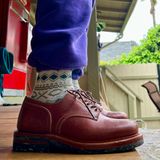
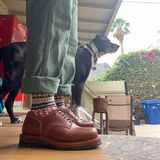
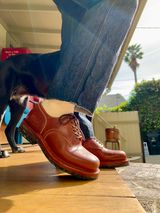
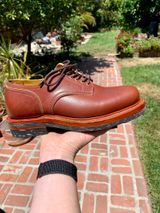
Conceria Cloe Mahogany Horsebutt is a custom-dyed vegetable-tanned horse leather produced by Conceria Cloe, an Italian tannery located in Ponte a Égola, Tuscany. The leather is distinguished by retaining the shell cordovan layer within the horsebutt cut, creating a material with tight grain structure and minimal creasing at flex points. The mahogany color varies in appearance under different lighting conditions, ranging from deep reddish-brown to chocolate tones.
The leather combines thickness with a soft hand feel, featuring subtle grain variation throughout the hide. Conceria Cloe uses a full vegetable tanning process taking up to six months, followed by hand dying and glazing to achieve the deep mahogany color and shiny surface finish. The material has been featured in premium footwear collaborations, including boots manufactured by Sagara.
Conceria Cloe Mahogany Horsebutt exhibits distinctive physical properties that differentiate it from other horse leathers. The retention of the shell cordovan layer creates an exceptionally tight grain structure, resulting in refined surface appearance and minimal visible creasing during wear. Despite the leather's substantial thickness, it maintains a soft temper with a dry, matte touch when unfinished.
The mahogany dyeing process produces color variation that changes under different lighting conditions. The grain pattern shows subtle variation across the hide, with some areas displaying more pronounced texture than others. The leather's high oil content contributes to its dense fiber construction while maintaining flexibility.
Physical specifications include a standard thickness of 1.8 to 2.0 millimeters. The material demonstrates natural water resistance and inherent abrasion resistance characteristic of horsehide. The leather is lighter and denser than cowhide while maintaining strength comparable to or exceeding bovine leather.
Conceria Cloe S.R.L. produces the mahogany horsebutt using traditional vegetable tanning methods in their Tuscan facility. The tanning process extends up to six months, utilizing pit tanning techniques for the horse culatta and avancorpo sections. The mahogany color is achieved through hand dying following the tanning process.
After dying, the leather undergoes glazing to produce the surface sheen characteristic of the finished material. No pigmentation is applied during production, allowing the natural grain variation and fiber structure to remain visible. The manufacturing process preserves the shell cordovan layer that would typically be separated for dedicated shell cordovan production.
The tannery's full vegetable tanning approach from upper through insole materials results in leather suitable for heritage footwear construction. The production method emphasizes natural characteristics over uniformity, with each hide exhibiting individual variation in grain pattern and color depth.
The mahogany horsebutt develops patina characteristics distinct from other vegetable-tanned leathers. The high natural oil content accelerates patina formation, with the surface developing a lustrous finish described as having an almost metallic sheen. The aging process creates what sources characterize as an imperfect, washed-out aesthetic.
During wear, the leather picks up nicks and scuffs that leave lighter marks against the mahogany base color. These marks can be addressed through conditioning, though many users prefer the natural aging character. The material softens with wear, becoming more comfortable over time while maintaining its structural integrity.
The aging process varies depending on use intensity and environmental exposure. The tight grain structure from the shell cordovan layer means vamp creasing remains minimal even after extended wear. The patina development follows patterns typical of vegetable-tanned horsehide, with high-wear areas developing deeper color and increased sheen.
Conceria Cloe Mahogany Horsebutt is primarily used in premium heritage footwear applications requiring durability and aesthetic development. The leather has been specified for boots including the Stitchdown collaboration with Sagara for the Bandung Derby. Sagara also utilizes the material in their Imperial IV and other boot models featuring handwelted construction.
The leather's properties make it suitable for applications requiring resistance to wear while developing character. The 1.8 to 2.0 millimeter thickness provides adequate substance for welted footwear construction without excessive stiffness. The material requires break-in time due to its initial firmness, though this decreases as the leather softens through wear.
Beyond footwear, the leather is applied in belts, watch straps, and small leather goods where the mahogany color and patina development characteristics are desired. The limited usable area per hide constrains production volume, contributing to the material's positioning in premium applications.
"Review: Sagara Imperial IV". Patina Project. Retrieved October 23, 2025.
"Horse Culatta - Cloe S.R.L". Mill Hand Made. Retrieved October 23, 2025.
"The Boondockers Cloe Nuda - Naturale". Sagara Bootmaker. Retrieved October 23, 2025.
"Horsehide Leather: The Ultimate Guide to Its History, Benefits, and Us". Leather Skin Shop. Retrieved October 23, 2025.